
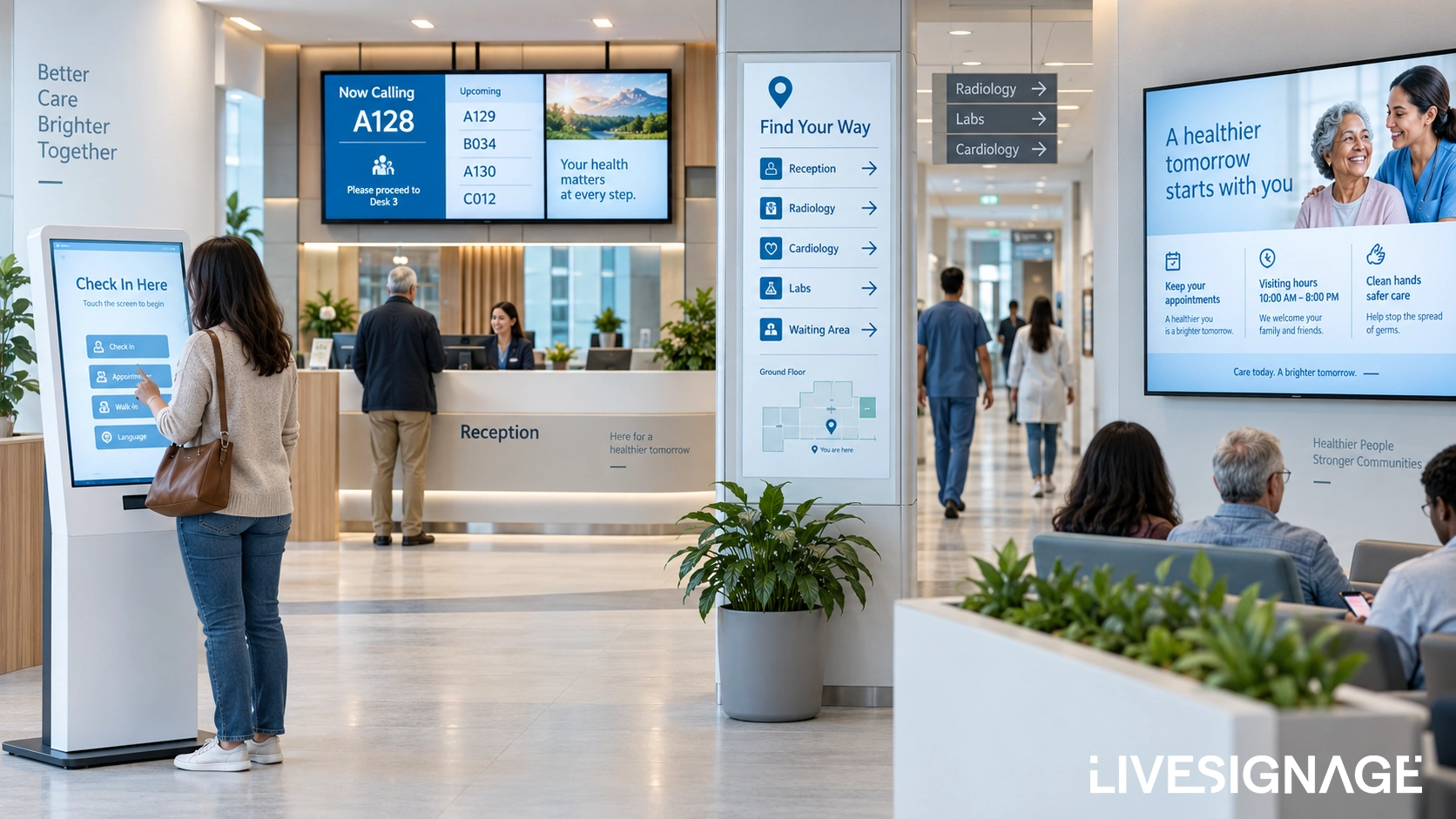
A patient walks into a hospital outpatient department. There are no signs telling them where to register. The waiting area has no indication of how long the wait will be. When their name is finally called, they miss it because they stepped away to find a bathroom. They return to the desk, confused and frustrated, and the appointment is delayed. Meanwhile, the pharmacy downstairs is still displaying a promotion that ended three weeks ago.
These are not exceptional failures. They are what happens when healthcare facilities treat communication as a secondary concern.
Why Waiting Rooms Are a Signage Problem First
Patient experience in healthcare is shaped disproportionately by what happens before the clinical encounter: the arrival, the registration, the wait. Research consistently shows that perceived wait time is often more damaging to satisfaction scores than actual wait time. A patient who knows they are number 14 in a queue, with an estimated wait of 22 minutes, tolerates the situation differently than one sitting in silence with no information.
Hospital digital signage addresses this gap directly. Not by shortening queues, but by making the experience of waiting legible. When patients can see their position, track their turn, and read relevant health information while they wait, the cognitive load of uncertainty is reduced. The environment shifts from passive frustration to managed expectation.
This is not a marginal improvement. It is a structural change in how a facility communicates with the people inside it.
The Three Communication Layers Every Healthcare Facility Needs
Digital signage for healthcare is not a single screen in a waiting room. It is a layered system that operates across three distinct functions: queue management, wayfinding, and patient communication.
Queue management is the most operationally critical. Patients need to know where they are in the process. Staff need to call patients efficiently without overhead announcements that disrupt the entire floor. A pharmacy counter serving 300 people a day cannot rely on paper numbers and a staff member shouting names.
Wayfinding is the most underestimated. A large hospital or clinic complex is genuinely difficult to navigate, especially for elderly patients, people with disabilities, or first-time visitors. Static floor maps at the entrance are insufficient. Dynamic wayfinding screens at key decision points, updated to reflect temporary closures, relocated departments, or construction detours, reduce the number of patients who arrive late or lost.
Patient communication screens serve a different purpose: they fill the waiting period with content that is useful rather than empty. Appointment reminders, preparation instructions for procedures, pharmacy pick-up alerts, health literacy content, updated visiting hours. This is where a digital bulletin board replaces the cluttered corkboard and the outdated printed leaflet.
What Changes When These Three Layers Run on One Platform
The operational problem with most healthcare signage deployments is fragmentation. Queue management runs on one proprietary system. Wayfinding is a printed map or a separate kiosk solution. Patient communication screens, if they exist at all, are managed manually by someone uploading files via USB drive.
Each system has its own interface, its own update process, and its own failure mode. When a department moves or a service is temporarily suspended, the information update has to happen in three separate places, often by three different people.
Livesignage consolidates these layers. Live Queue Pro handles patient flow, displaying ticket numbers, estimated wait times, and counter assignments on screens throughout the facility. Live Billboard manages the patient communication layer, pulling content from calendars, internal systems, or manually curated sources, and displaying it without requiring design work every time something changes.
Both apps run on the same platform, managed from a single interface. A change made centrally, such as a department closure or an updated visiting policy, propagates across every relevant screen automatically. This is where Livesignage's Experience Designer becomes operationally relevant: triggers and flows can be configured so that, for example, a queue threshold automatically changes the content displayed in a waiting area, or a specific screen shows different information depending on the time of day.
Where Pharmacy Signage Has Its Own Requirements
Pharmacies operate differently from hospital departments, but the signage requirements overlap more than they diverge. Queue management is central, particularly in high-volume retail pharmacies or hospital dispensaries. But pharmacies also need to communicate product availability, promotional offers, health campaigns, and regulatory information.
The problem with most pharmacy signage systems is that promotional content is managed separately from operational content. A screen showing a vitamin D promotion has nothing to do with the queue display, and both are managed by different people with different tools. The result is that promotional content goes stale, queue displays are functional but visually disconnected, and the overall environment looks assembled rather than designed.
A unified platform allows a pharmacy to run queue management and promotional content on the same screen, or on adjacent screens that are visually coherent and centrally managed. When a product line changes, the update happens once. When a health campaign ends, the content is removed automatically based on a scheduled date, not because someone remembered to log in and delete it.
Across pharmacy networks that have moved to automated content management, the reduction in manual editing work is significant. Facilities that previously required daily updates to keep signage current have reduced that workload by as much as 73%, freeing pharmacy staff to focus on dispensing rather than screen management.
Measuring What Healthcare Signage Actually Delivers
The question that operations directors in healthcare ask is not "does digital signage work" but "what does it change, and how do we measure it". The answer depends on which layer you are measuring.
Queue management systems produce measurable data: average wait time, peak load periods, counter utilization rates. Wayfinding improvements are harder to quantify directly, but proxy metrics such as staff time spent redirecting lost patients, or the frequency of late arrivals to appointments, provide a baseline. Patient communication screens are typically measured through satisfaction surveys, where facilities using structured waiting room content report substantially higher scores on communication-related questions.
In healthcare environments where patient communication screens were integrated with queue management and appointment systems, engagement with screen content increased by 85% compared to static poster environments. The mechanism is straightforward: when content is relevant and timely, patients pay attention. A screen showing your queue number alongside health information relevant to the department you are visiting is not background noise. It is useful.
When a Platform Review Is Worth the Effort
Healthcare facilities that are still running fragmented signage systems, separate queue management software, printed wayfinding, and manually updated screens, are paying a cost that is not always visible in the budget. It appears in staff time, in patient complaints, in the gap between what a facility communicates and what patients actually understand.
The case for consolidation is not primarily about cost reduction. It is about operational coherence: one platform, one interface, one update that reaches every relevant screen. If your facility manages more than two locations, or more than one department with active patient flow, the complexity of fragmented systems compounds quickly.
If you want to see how queue management, wayfinding, and patient communication can operate as a single system across your facility, you can book a demo with a Livesignage specialist.