
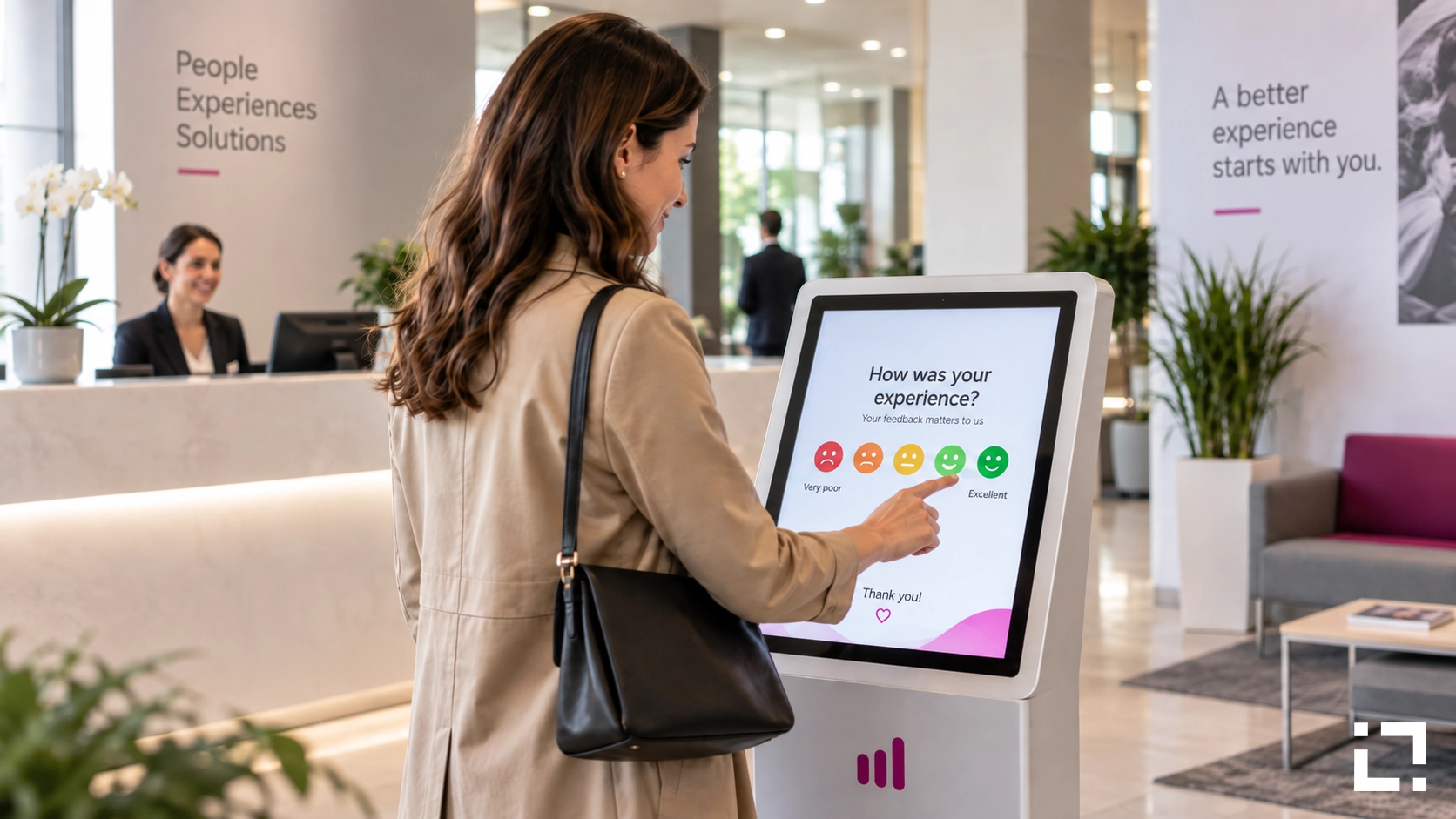
A hotel chain with 12 properties runs a paper comment card at checkout. Response rate: around 3%. The cards that come back are mostly blank, occasionally illegible, and arrive at the marketing team three weeks after the guest has left. By then, the problem that generated the complaint—a slow check-in process, a noisy room, a breakfast item consistently out of stock—has already repeated itself dozens of times.
The gap between when feedback is available and when it gets collected is where customer experience erodes. A digital survey kiosk placed at the right moment in the customer journey closes that gap entirely.
Why Paper and Post-Visit Surveys Fail to Capture Useful Data
The problem with traditional feedback methods is structural, not cosmetic. Paper forms depend on voluntary effort from customers who are already mentally somewhere else. Email surveys arrive hours or days after the experience, when recall has faded and motivation has dropped. Response rates for post-visit email surveys typically hover between 5% and 15%, and the sample skews heavily toward people with extreme experiences—very satisfied or very frustrated.
The result is data that looks like feedback but behaves like noise. You can calculate an average score. You cannot identify a pattern in a specific location, a specific shift, or a specific service touchpoint.
An in-store survey or touch screen survey placed at the point of experience—at the checkout counter, the waiting room, the hotel lobby, the end of a clinical consultation—captures responses while the experience is still present. Response rates in on-screen kiosk environments consistently outperform email surveys by a significant margin, precisely because the friction is close to zero. One tap. Done.
What Conditional Logic Changes in a Touch Screen Survey
Most survey tools collect answers. A well-designed digital survey kiosk does something more useful: it adapts the question flow based on what the respondent just said.
This is where conditional logic becomes operationally relevant. If a patient rates their wait time as poor, the next screen asks specifically about what contributed to the wait—staff availability, unclear signage, appointment scheduling. If they rate it positively, they move to a different branch of questions about clinical communication or facility comfort. Two respondents, same starting point, different paths, both producing structured and actionable data.
Without conditional logic, a survey is a form. With it, it becomes a diagnostic instrument.
Livesignage's Live Survey module is built around this principle. Flows are configured visually in the no-code Experience Designer: you define conditions, branches, and endpoints without writing a single line of code. A retail operations manager can build a post-purchase satisfaction survey in the morning and deploy it to 40 locations before lunch. No developer involved, no IT ticket.
Multilanguage Surveys Without Duplicate Configurations
Deploying a customer feedback display across multiple countries, or even across a single city with a diverse customer base, introduces a translation problem that most platforms solve badly: maintain one survey per language, keep them synchronized manually, hope nothing drifts.
Live Survey handles multilanguage at the content layer, not the structural layer. You build the survey logic once. Language variants attach to the same flow. When a respondent selects their preferred language on the opening screen—or when the display detects a language preference based on context—the correct text renders automatically. The conditional logic, the branching, the answer options: all consistent across every language version.
For a hospital system serving patients who speak five different languages, this is not a convenience feature. It is the difference between a survey that produces comparable data across populations and one that produces five separate datasets that cannot be meaningfully aggregated.
From Raw Responses to Operational Decisions
Collecting feedback is only useful if the data moves somewhere actionable. A customer feedback display that stores responses in a local database, accessible only by exporting a CSV file once a month, is not a feedback system. It is a digital suggestion box.
Live Survey connects to the Livesignage analytics dashboard, where responses aggregate in real time across all deployed kiosks. A retail operations director managing 25 stores can see, on a single screen, which locations are generating negative scores on product availability, which shifts correlate with lower satisfaction ratings, and which specific questions are producing the most divergent answers between sites.
This is the kind of visibility that makes feedback data worth collecting. Across networks where Live Survey has been deployed with this level of integration, the increase in active engagement with feedback touchpoints reached +85% compared to equivalent paper or passive digital alternatives—driven by the immediacy of the interaction and the visible responsiveness of staff when issues were acted on quickly.
If you want to see how this looks in a live environment before committing to a configuration, book a demo with a Livesignage specialist and walk through a configured survey flow for your specific sector.
Where a Digital Survey Kiosk Fits Across Sectors
The same underlying capability applies differently depending on the environment.
In retail, a touch screen survey at the exit captures sentiment about the in-store experience, staff helpfulness, and product availability. Linked to transaction data, it can flag stores where satisfaction scores drop on high-traffic days—a signal about staffing ratios, not just service quality.
In healthcare, a kiosk in the waiting area or at the end of a consultation captures patient experience data that is increasingly required for accreditation and quality reporting. Conditional logic ensures that clinical and administrative feedback are separated cleanly, with appropriate routing for urgent concerns.
In hospitality, a survey kiosk at checkout or at the end of a restaurant meal captures feedback before the guest leaves the property—when there is still an opportunity to recover a poor experience rather than read about it later in a review.
In corporate offices, end-of-meeting room surveys or lobby check-in kiosks collect data on facility satisfaction, meeting room quality, and hybrid work experience—inputs that facility managers rarely have access to in structured form.
When to Move from Ad Hoc Tools to a Dedicated Feedback Platform
Many organizations start with a generic survey tool—a tablet running a web form, a QR code linking to a third-party form builder. These work at small scale. They stop working when you need to manage 10 or more locations, when you need multilanguage support, when you need conditional logic, or when you need the feedback data to connect with other operational systems.
The signal that it is time to move is usually not a single failure. It is the accumulation of small inefficiencies: survey links that break, translations maintained in spreadsheets, response data siloed in a tool that does not talk to anything else, and a growing gap between what the data says and what operations can act on.
Live Survey is designed for organizations that have already outgrown ad hoc tools and need a feedback layer that scales with their network. If you manage customer-facing displays across multiple locations and want to understand what structured, real-time feedback collection looks like in practice, you can book a demo with a Livesignage specialist and see a configured environment built around your sector.