
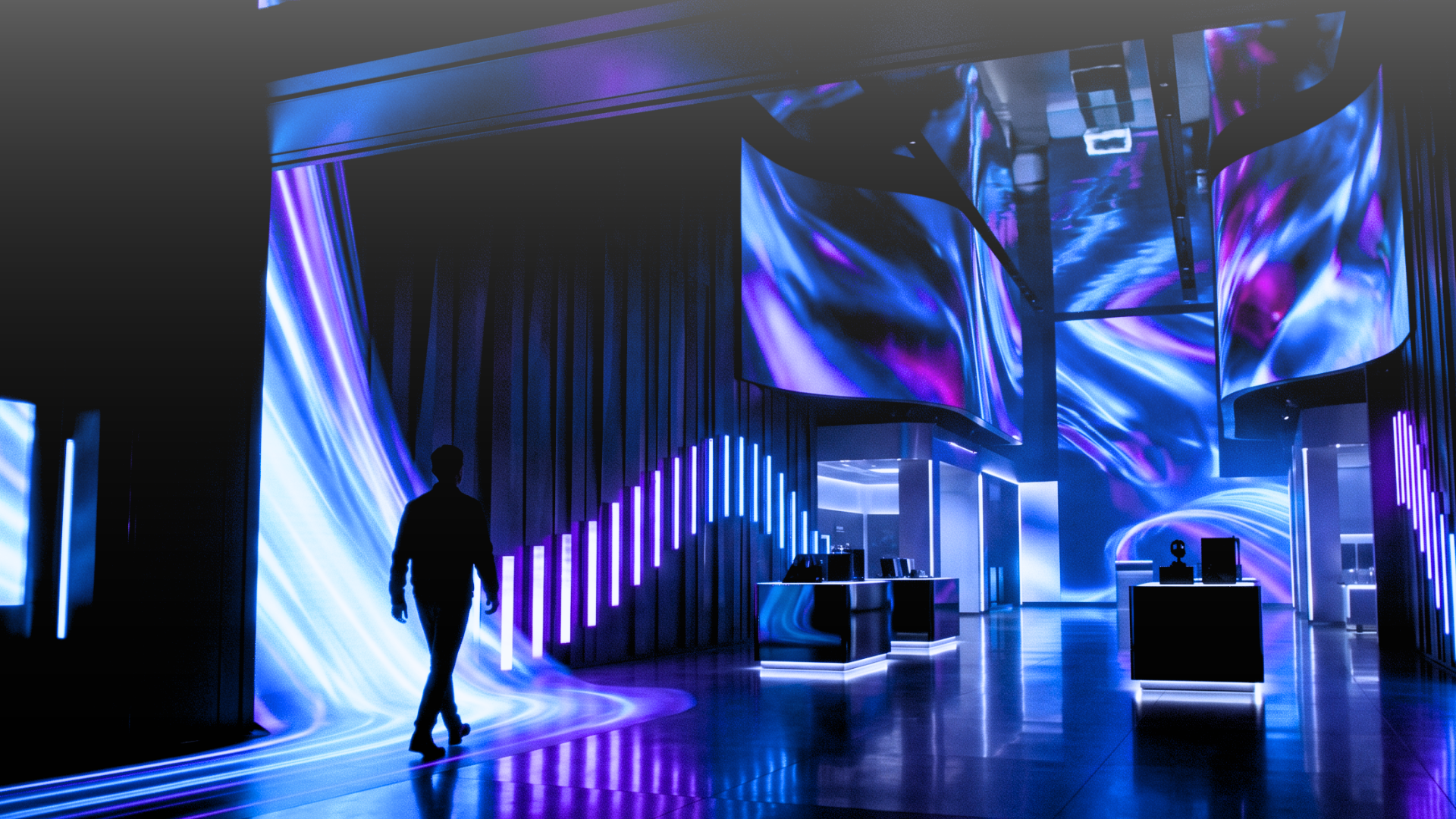
A luxury car brand opens a new showroom in a city where floor space costs more per square metre than most companies spend on entire fit-outs. They cannot display fifty models. They display six — and use immersive digital signage to let every visitor configure, experience and emotionally connect with any model in the range. Screens, lighting, audio and projection respond to what the customer touches. The room changes around them. The salesperson never needs to interrupt the experience; the environment supports the sales process.
This is not a concept. It is what orchestrated showrooms look like when the technology is built to coordinate, not just display.
Why Most Showrooms Still Feel Like Waiting Rooms
The standard approach to showroom technology is additive: a screen here, a tablet there, a video loop running on a display near the entrance. Each element works independently. None of them respond to each other, to the visitor, or to what is happening in the room.
The result is an environment that looks modern but behaves passively. A visitor walks past a screen showing a product they are not interested in. The audio plays regardless of who is in the room. The lighting stays the same whether the space is empty or hosting a VIP presentation. Nothing adapts.
This is the gap between digital decoration and immersive digital signage. One fills wall space. The other shapes an experience.
For retail and corporate environments where the physical visit is the primary sales moment — automotive, real estate, luxury goods, B2B technology, high-end hospitality — that gap can translate into missed conversion opportunities.
What Orchestration Actually Means in Practice
Orchestration means that every element of the physical environment — screens, projectors, lighting rigs, audio zones, sensors — operates from a single control layer, responding to the same triggers and following the same logic.
A visitor steps into a product zone. A floor sensor registers their position. The nearest display switches to the relevant product. Ambient lighting shifts to match the product's colour palette. Audio fades in with a short narrative. A large-format projection wall renders a 360-degree environment. All of this happens in under two seconds, without anyone pressing a button.
The same logic applies to scheduled experiences. A corporate showroom running a client presentation at 14:00 can have every room element — welcome screen, meeting room booking confirmation, product wall, audio — transition automatically at the scheduled time, with no manual intervention from staff.
This is what Live Controller, Livesignage's orchestration engine for immersive rooms and showrooms, is designed to manage. It connects displays, lighting, projectors, audio systems and sensors into a single coordinated layer, controlled by rules, schedules and real-time triggers.
Designing the Experience Without Writing Code
The technical challenge of immersive environments has historically been the barrier to adoption. Coordinating multiple device types, defining trigger logic, building interactive flows — this required specialist AV integrators and significant development time. Changes to the experience meant going back to the integrator. Updating a product story for a new launch could take weeks.
The Livesignage Experience Designer removes that dependency. It is a visual, no-code environment where operators define flows, set triggers, assign actions to devices and preview the result — without touching a line of code.
A marketing manager can build a product presentation flow that starts when a visitor scans a QR code, progresses through three content chapters, adjusts room lighting at each transition and ends with a contact form on the nearest touchscreen. They can test it, adjust the timing, swap the content and republish — all within the same session.
This matters operationally. When a product launch happens on a Thursday, the showroom experience can be updated by Friday morning. When a client visit requires a customised presentation, the room can be configured the night before by the internal team, not an external contractor.
The Engagement Gap Between Passive and Interactive Environments
The difference in visitor behaviour between a passive screen environment and a fully orchestrated interactive showroom is measurable. Across Livesignage deployments in retail and corporate showroom contexts, interactive immersive environments produced an 85% increase in engagement compared to standard display setups — measured by dwell time, interaction rate and content completion.
That figure matters because dwell time in a showroom correlates with conversion. A visitor who spends twelve minutes in an interactive product environment, configuring options and experiencing different scenarios, is in a fundamentally different position from a visitor who glanced at a looping video and moved on.
The engagement difference is not about spectacle. It is about relevance. When the environment responds to the visitor — their choices, their position, their pace — the experience feels personal. That perception of personalisation encourages longer dwell times and increases the likelihood of a next step.
Where Multi-Device Coordination Changes the Sales Conversation
In a complex B2B showroom — industrial equipment, enterprise software, commercial real estate — the sales conversation is rarely a single moment. It is a sequence: an initial overview, a deeper product demonstration, a use-case walkthrough, a pricing discussion.
An orchestrated environment supports each phase without requiring the salesperson to manage the technology. The room transitions between modes as the conversation progresses. The demonstration wall shows the relevant product configuration. The secondary screen displays the relevant case study. The audio drops out when the salesperson begins speaking and returns when they step back.
This keeps the salesperson focused on the conversation, not on operating the room. It also ensures that every client visit follows a consistent experience structure, regardless of which team member is presenting.
Live Controller supports this through programmable scene sequences — predefined room states that can be triggered manually by the presenter or automatically by a schedule or sensor event. A single button press on a tablet moves the room from welcome mode to demonstration mode to wrap-up mode, with every connected device responding accordingly.
When an Orchestrated Showroom Is Worth Building
Not every retail or corporate environment needs full AV orchestration. A single-location boutique with three screens and a straightforward product range does not need a multi-device control layer.
The investment makes sense when the physical visit is the primary conversion moment, when the product range is complex enough to benefit from contextual presentation, or when the brand experience needs to be consistent across multiple rooms or locations.
For automotive, luxury retail, real estate, enterprise technology and high-end hospitality, those conditions frequently apply. The showroom experience becomes an integral part of the product experience itself.
If you manage a showroom environment and want to see what a fully orchestrated immersive experience looks like in practice, you can book a demo with a Livesignage specialist.